
To track or not to track
January is all but behind us

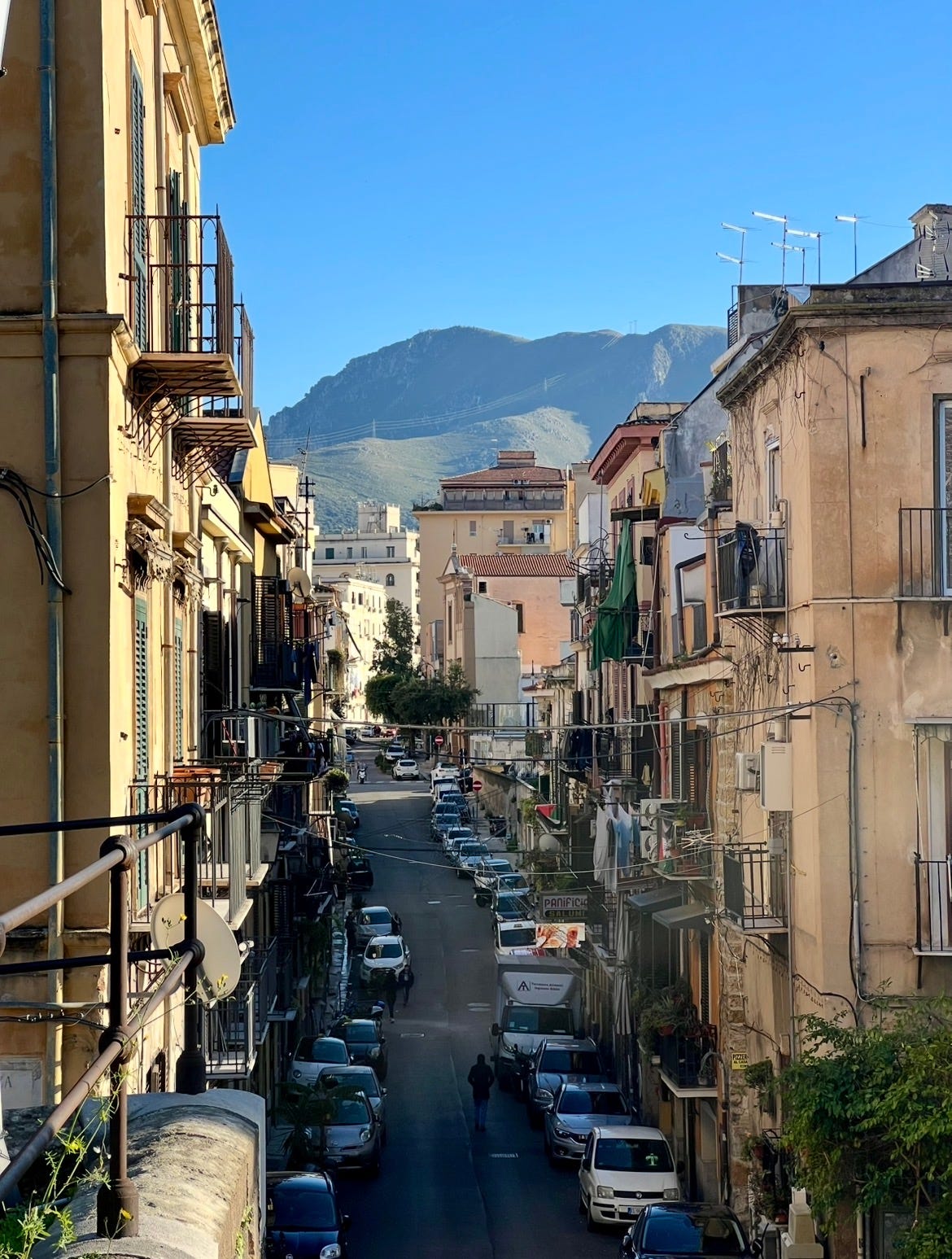
Ciao from Palermo. I’ve been here for a couple of weeks now, and I’m not sure when exactly I’ll be back in Dublin — insert logistical considerations of interest to no one but me. It’s relatively warm here and the people are fantastic.
I’m making decent progress with learning off Arabic lemmas. I’m already noticing differences in media language from doing it, e.g. that Al Jazeera always specify the occupying Israeli army the first time they’re mentioned in an article, and that they don’t follow the Western tendency to say ‘hostages’ for Israelis and ‘prisoners’ for Palestinians. Looking with a degree of dread at my work calendar, I think April is the earliest I’ll be able to properly lock in with Arabic, i.e. start the Al Kitaab books and give myself a deadline to finish them. (I do not learn languages properly without a deadline.) But in the meantime it’s better than nothing to add a few drops every day to the ocean of words I’ll need.
It’s steadily along with the Irish-language novel, too. A decent January considering it’s my most despised month. (A calendrical take that is classic for a reason.)
*
January reads
I tried a new thing recently by sharing what I’d read in January on Instagram. Here’s the list:
What I read in January
# = still reading
** = especially enjoyed
English
**Call Me Ishmaelle — Xiaolu Guo (2025)
French
Je ne suis pas sortie de ma nuit — Annie Ernaux (1997)
Journal de dehors — Annie Ernaux (1993)
#La honte — Annie Ernaux (1997)
**Passion simple — Annie Ernaux (1988)
Trois contes — Gustave Flaubert (1877)
German
Brief an den Vater — Franz Kafka (1919)
Irish
#Dílis — Réaltán Ní Leannáin (2015)
**Cré na Cille — Máirtín Ó Cadhan (1949)
Diabhlaíacht Dé — Micheál Ó Conghaile (2015)
Italian
#Non scusarti per quel che hai fatto — Mahmud Darwish tr. Sana Darghmouni e Pina Piccolo (2025)
#Lettere del carcere — Antonio Gramsci (1971)
La Sicilia non esiste — Gaetano Savaretti (2025)
Spanish
#Del amor y otros demonios — Gabriel García Márquez (1993)
Swedish
En droppe midnatt — Jason Timbuktu Diakité (2017)
**Singulariteten — Balsam Karam (2021)
**Herrarna satte oss hit — Elin Anna Labba (2020)
Män som hatar kvinnor — Stieg Larsson (2005)
Den dag jag blir fri — Lawen Mohtadi (2012)
Feminismens idéer — ed. Hanna Östholm (2006)
Björnkvinnan – Karolina Ramqvist (2022)
I wrote a little about some of these in my Irish-language newsletter. Of the rest, Call Me Ishmaelle is sublimely enjoyable with wonderfully weird prose; Guo uses writing in a second language to active stylistic advantage, producing shimmers of defamiliarisation that are very much controlled and deliberate. Project Read Every Ernaux continues to go well; I’m on 9/22 now, but my favourite is still 6/22 Passion simple because the misery of an affair is, I guess, less grim than the misery of class violence or losing a parent? — though the way Ernaux writes about love, it’s not far off. And I’m still thinking about Balsam Karam’s Singulariteten; it’s about how memory and grief aren’t linear, with some particularly fine and diametrically opposed formal choices in the last two sections. There’s an English translation by Saskia Vogel from Fitzcarraldo called Singularity. (*I foggily thought this had been changed from it being plural in the original, but that was my brain running in German. Roll on February, I’m exhausted.)
I don’t think I’ll keep tracking like this; much as I love data, I worry that in the long run it would make reading feel like a chore. But it was fun to do it once.
The thing is, I’m a fiend for tracking certain other things. I frequently skim over the calendar on my yoga app to congratulate myself on streaks and figure out what went wrong during gaps. When I’ve started learning a new language, I literally keep an iPhone note of how many hours I have spent studying it to date; otherwise I get impatient and fall prey to ‘I’ve been doing so much for so long and I’m still really bad’ when the objective reality is that the hours say I can’t expect to be good yet. I think the rubric for me on whether to track things is: do my natural patterns and inclinations already produce the outcome I want? In the case of reading, they do; I have been a bottomless book pit since I was three years old, and I’m happy enough to be one. I am not a bottomless slowly-becoming-stronger-and-more-flexible pit or a bottomless drilling-the-conditional-mood pit, so I track those things to make sure I’m doing enough of them.
*
Criteria for enjoying people
The other day I was talking to a 60-year-old woman who, within five minutes of our conversation, showed me a picture of her son. ‘Bello’, I said without really looking, and she immediately video-called him to introduce him to the unmarried Italian-speaking foreigner who’d called him handsome. (He was, it transpired.) She’d never heard of Ireland — my ‘Guiness-ə, Joyce-ə, Dublino’ rang no bells — so I think she left the exchange with the vague impression that I was some sort of Scandinavian. As we said goodbye, she asked my star sign. It transpired we were both Aries. I get along either very well or very poorly with fellow Aries — usually it comes down to whether they are Let’s Push Each Other to Both Be Better competitive (fun! energising!) or This One Needs Taking Down a Peg or Two so I Can Be Better than Her without Having to Change competitive (boring, next) — but she was definitely one of the good ones.
This got me thinking about my criteria for whether I enjoy people, because sometimes I enjoy them hugely and sometimes I don’t at all, and if I had a broad-strokes model I could better predict how to allocate my emotional energy. As far as I can make out, it comes down to: 1. commitment to the project and 2. friction.
Commitment to the project
Quite simply: are they actually trying to get this over the line? Do they actually want to get it done? ‘It’ encompasses all possible things that people could want from me, even the shortest of exchanges.
An ex once told me that I am impatient with normal human limitations because I myself am unusually decisive. It was a fair observation of something I hadn’t realised myself — maybe it’s not that the world is full of bizarrely oscillating souls, but that I am an outlier re: clarity and followthrough — but it didn’t change how I operate, because of course my preferences will be calibrated to my emotional architecture and that’s not really something I can change. So. People who can achieve some kind of internal lucidity about how much or little they wish to interact with me, and whose energy confidently reflects whatever conclusion they’ve arrived at … yes please.
Sicilian 60-year-old woman was perfect at this. She talked to me for exactly the duration she wanted to, and gave it socks as long as she did. English people are dire at it; they will neither commit to the conversation nor let you leave.
Friction
There are good kinds and bad kinds. Bad friction is when I have to tiptoe around fragile egos. It’s a challenge — and I like those, oh yes! — but it’s not one that I can meaningfully learn from in ways that will help me with anything else; it’s largely about the individual’s specific triggers, bugbears and sore spots. It’s not guaranteed that I can ever establish a reliable pattern: insecure people get set off in ways that are unknowable and chaotic. Even if I could truly manage them, steer them just right, I would feel manipulative and paternalistic knowingly doing so — and I am, alas, too autistic to do it unconsciously. So I just don’t play.
Good friction is when someone pushes me to the edge of my abilities in skills I actually want to improve. It could be intellectually, it could be linguistically if we’re speaking one of my L2s, it could be emotionally if they’re grilling me on my life choices. It’s all welcome.
There you have it. This information is probably useless to anyone besides me, but it was satisfying to articulate it to myself. So actually, perhaps that’s another use I have for tracking/data: not necessarily to make myself do things, but to understand in their totality things that seem opaque to me on a granular level.
*
Hope you all held up. See you in February.
N
Ugh to the age-related paradox. Your story about the 60-year-old woman sparked two immediate thoughts, “oh how nice, she’s open to conversations with this older lady,” and then, “oh yeah, I’m actually 62! that sounds so old” ::grimace::
Aging is inevitable but when you’re young, it’s rarely a consideration, unless you’re interacting with older people and it seems relevant to include in your internal narrative, “I’m enjoying this conversation and they are so much older, and (but) that’s ok.” And then you blink and all of a sudden it’s YOU who is past 60…that sounds unbelievably old, but internally you feel exactly as you did at 35.
I appreciate your writing. And the age-related musings can be ignored, grazie :)
What I got from that conversation is how bad is the Italian education system. She’s only 60 and doesn’t know Ireland. Relatively young and doesn’t about us!