
Shut up and sanction
I hate Ireland sometimes

It’s been quite a week.
Just as the Irish government narrowly voted down full sanctions against Israel, the news emerged that Israel is getting more audacious still with its treatment of flotilla participants. The last time they experienced actual consequences was when they murdered 9 people on the Mavi Marmara in 2010. The diplomatic fallout was nowhere near as grave as the situation warranted — of course it wasn’t, it’s Israel — but it was enough that they concluded: okay, we can’t directly shoot at them, that one’s off the menu, noted. Since then they’ve been testing the waters on what else they can do, and each abuse they get away with emboldens them to try more next time.
My friend Hannah recently told me that after I got back from Israeli prison myself last autumn, my shoulders stayed tensed up by my ears for months afterwards. ‘They’re only just starting to come back down now’, she said. I really did think I seemed fine to everyone, and the whole time my posture was like PLEASE PLEASE PLEASE DON’T HURT ME. In hindsight I can see how I was a bit off psychologically with people in those first few months too: timid and accommodating and constantly making everything my fault, in a way that didn’t really register as an obvious problem to the world at large and no doubt seemed in certain quarters an improvement (finally, Dolan comprehends how a woman is supposed to be). But it was probably alarming to people who are used to my being, you know, a lot.
What I experienced was absolutely nothing in the grand scheme of things, and particularly not in the vile tawdry scheme of how Israeli prison guards treat Palestinians. But even my microdosed encounter with the Israeli system clearly left enough of a mark that for months afterwards, I spent every waking hour arched up like a hissing cat. This cannot be reformed. This cannot be worked with. It is surreal that anyone is still trading with them.
The strongest devil’s advocate argument against full sanctions, I suppose, is that they could hurt the efforts of some Israelis to change things from within. It’s not clear economically why those people particularly would be affected above anyone else in Israel: given how the international left versus right tends to feel about funding literally anything there, I really don’t think the disproportionate financial risk exposure lies where this argument implies. Hearts-and-minds-wise, ‘They’ll double down when they feel isolated’ is rather a vague and unverifiable claim compared to the undeniable material fact that any money going into Israel ultimately pays for bullets fired at children’s heads. Also, though, let’s call this argument what it is: liberal Zionism. It is liberal Zionism to think reform within the Israeli state is possible and that this dim chance is worth continuing to fund the slaughter of Palestinians. If people want to declare themselves openly as liberal Zionists and have a debate on that basis, at least that’s honest. But most of the Irish politicians who voted No this week would get pissy with you if you called them that. They’re ‘pro-Palestine’, just not right now, just not when it might mildly inconvenience them.
I sometimes tell people I was born to be a lounge lizard — destined to be a perfectly useless bon mot dispenser who lingers on other people’s chaises, rotates three French lovers and tosses a book out every few years. In any previous generation, I probably would have been precisely that; it’s just not tenable in this one. No vaguely sentient person can stay out of things now, right? So you’d think! This is maybe the area where I feel most split between my writing life and my political involvement: politically I think it is a waste of time to analyse individual motivation rather than systems, but novelistically I cannot but be fascinated at how people live with what they’re doing. Do they think it through explicitly? ‘On the one hand there is a genocide, on the other hand I would endanger my standing within my centre-right party if I voted to stop funding it, clearly one of these things is more important than the other and it’s not the genocide that’s for sure’? Probably that’s not how it happens, probably it’s abstract and they distract themselves with whatever boilerplate about politics being the art of getting things done. Until you’ve specified which things and why they’re worth it, that’s not pragmatism; it’s jargon and fluff.
Ireland has different problems to Germany. There, they are openly denying the Ulm 5 a fair trial and making every attempt they can to publicly break them. Here in Ireland, they’re trying to make it so costly and exhausting for the likes of the Boeing 3 that other direct actionists drop off without generating much public attention. It’s pretty much impossible to demonise anyone, exactly, for being pro-Palestine in Ireland. But you can erode them bit by bit. You can price them out of it with huge fines and dragged-out proceedings.
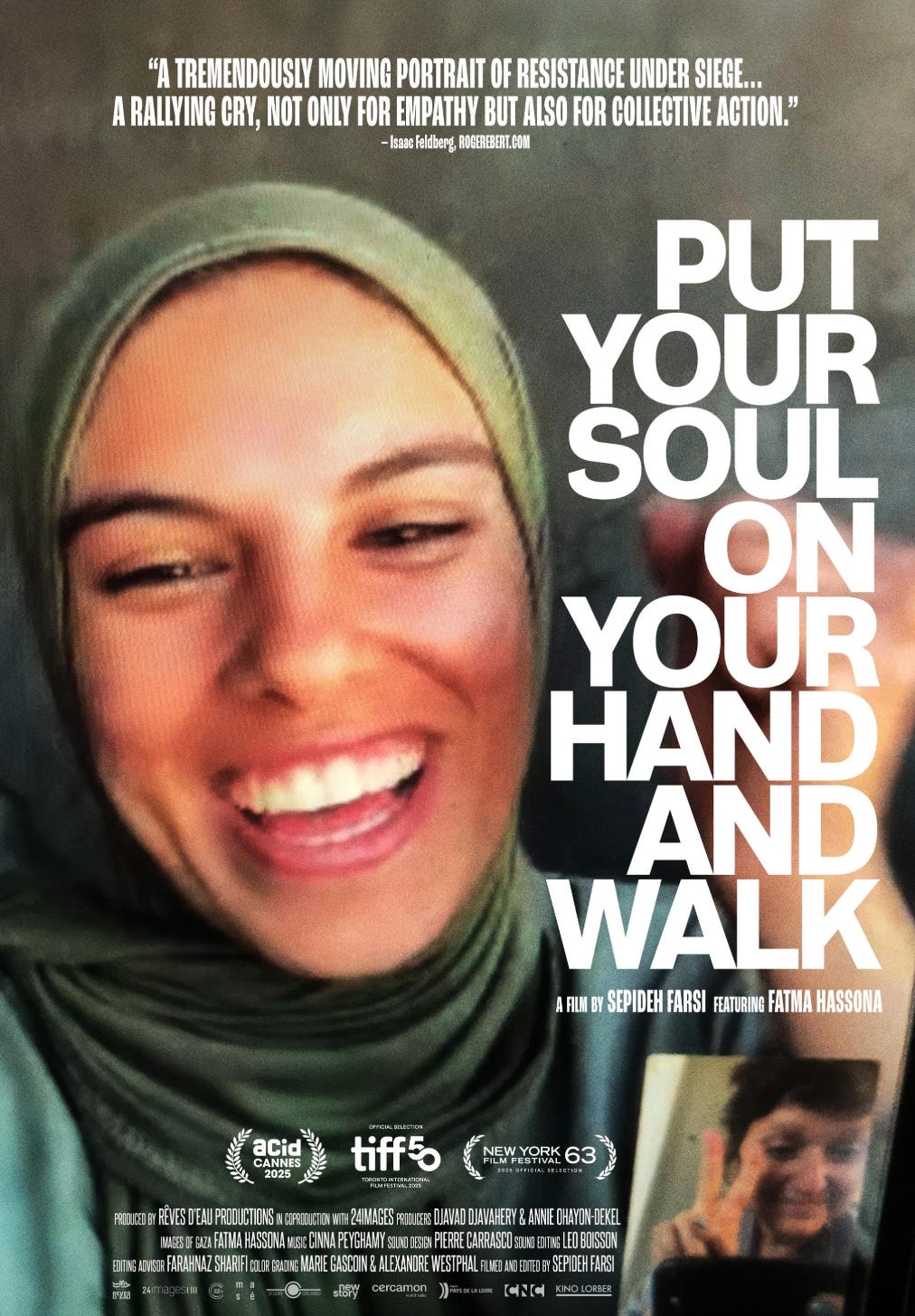
Last Friday, at the International Literature Festival Dublin, I interviewed Iranian filmmaker Sepideh Farsi about her 2025 documentary Put Your Soul on Your Hand and Walk. The film depicts life in Gaza during the genocide through videocalls between Farsi and Palestinian photojournalist Fatima Hassouna, one of a generation of young artists and thinkers in Gaza who suddenly had to become a war reporter simply because it was impossible to be anything else. I loved how Farsi conveyed that Hassouna had wanted to be a photographer, not a news reporter: we see many of her photos, their distinct composition, their point of view, and we know she had so much more to say than that a genocide is happening. Now she’ll never be able to; Israel murdered Hassouna the day after she learned the film had been selected for Cannes.
Again, I know this question is too individualist to be useful politically. But again, I can’t help asking: can anyone see Hassouna’s smile, and see the gradual exhaustion and distance that settle on her face as the destruction of her city continues, and see her irrepressible curiosity and openness to the world resurfacing anyway sometimes, and then just carry on voting down every attempt to stop the murder of her people? They can, they do, that’s why it’s pointless to even ask. People do all sorts of things they can’t honestly defend. But I’ll never really believe it. It will never settle in.
‘What’s useful, so?’ — organising against them, obviously.
The day before interviewing Farsi, I was at a rally for Yves Sakila, a Congolese man whom Arnotts security guards murdered on 15 May. It was a funeral – a school friend of his spoke, and thanked me and a couple of friends for coming afterwards like you would at any other ceremony – and it was necessarily political too. The Congolese and Black communities in Ireland do not have the luxury of decoupling grief from calls to action. They can’t pretend not to know why Yves died, who killed him, that it will happen again if nothing changes.
Micheál Martin has said things about Yves Sakila. He’s said things about Palestine, too. Meanwhile Irish money keeps flowing to Israel; meanwhile parties like his keep creating the conditions for racist violence with increasingly dogwhistled rhetoric. This isn’t surprising, of course, nor even disappointing – disappointment requires holding even a minor expectation of anything else – but it will never not be infuriating. Mo náire iad.