
Autistic ambiguity
+ Assimil L’arabe

Through learning Arabic — listening and reading when I still barely understand anything — I’ve been thinking lately about the forms of ambiguity that different people can handle.
For me, cognitive and abstract ambiguity is fine; that is how I enjoy literary fiction and believe in God. Social ambiguity, however, is a nightmare. I think this discrepancy is because I see cognitive and abstract ambiguity as necessary: some concepts are inherently hard to pin down, and we would unforgivably impoverish our thinking and our spiritual lives if we tried to make them simpler. Social ambiguity seems, however, to create unnecessary interpretative work over what could have been a simple yes or no, and so I’m rather impatient with the whole thing. Of course a lot of people do find ambiguity easier than directness in many situations. Probably the majority does, and that’s why society carries on with it, and that’s fine. Annoying for me, but fine. Not every autism-related inconvenience is a form of oppression.
What I do find grating is the simplified perception that neurotypicals can deal with ambiguity and autistics can’t. What sort of ambiguity, exactly, do you mean? (I realise that by asking this question I’m perhaps not beating the stereotype.)
For instance, I’m still not sure if people are exaggerating when they say they ‘can’t’ yet read in a language they’re learning without a dictionary, or if they genuinely find the ambiguity of too many new words so debilitating that they physically cannot continue. Maybe it’s not everyone’s preferred activity, maybe it sucks for them — but surely that’s a ‘don’t want to’ situation, not a ‘can’t’. Or is it actually a ‘can’t’? I’m open to the possibility that it is! Maybe people experience something different in their bodies to what I do when they’re reading something where they don’t know most of the words — an overpowering headache? A physical inability to focus on the page? — but I’ve never felt this ‘can’t’ myself, nor heard anyone articulate what it’s actually like for them, and so I do not understand it. In any case, it’s either an actual physical intolerance for, or strong dislike of, ambiguity that many people have in this domain and that I do not. I was reading in German from day one, forcing myself to figure the language out on its own terms, and that’s how I learned it quickly.
Take an inverse case: if I’m making plans with someone a few days in advance and they say let’s play the exact time by ear, this creates masses more cognitive work for me than if they’d just offered a time, any time. I have to now model multiple versions of that day based on the different time possibilities, holding all of these in working memory until it’s clear which time it will actually be. I also have to decide during the exchange itself if they are asking to play the time by ear out of genuine scheduling uncertainties on their part, or simply out of a desire to keep our interaction chill. If it’s the latter then I will certainly torpedo this objective of theirs by asking WHICH TIME?! and so I don’t.
The latter form of intolerance for ambiguity (can’t hack not knowing which time) is pathologised as stereotypically autistic. The former (can’t hack an onslaught of new words) is just how people are, with no change required on their part. I suppose you could say pragmatically: well, most people get on fine in life without being able to do your thing, while it causes you a fair amount of friction that you can’t do theirs. But my ‘can’t’ is as insuperable as their ‘can’t’, and the desire to make life easier for myself won’t override it. Would that it could! You think I like negotiating between the WHICH TIME inner gremlin and the perennially loud DON’T EVER, UNDER ANY CIRCUMSTANCE, TELL ANYONE WHAT YOU ACTUALLY NEED FROM THEM?
(A lot of autistic women have that, and I don’t think it’s necessarily about people-pleasing. I have never been hugely preoccupied with being liked, exactly, so much as with not being found out. As what? — well, the essential horror was that I didn’t know. But there was something unidentifiably awful inside me that required concealment at all costs. The specific things I needed were markers of this unidentified badness, and so I couldn’t ask for anything from anyone without letting the auld cat right out of the bag.)
*
Currently I’m halfway through Assimil’s L’arabe textbook. They claim it will get you from zero to B2, which is mathematically impossible on two levels: it only covers around 1,500 words as opposed to the c. 2,500 required in active vocabulary alone, and by their suggested pace of 30-40 minutes per lesson it should take around 40-50 hours to finish. Even doubling that time to allow for their second activation phase where you go back and translate all the French into Arabic, that’s still barely enough total study time to take you to A1. No textbook alone can get you to B2, of course, but this particular ratio of textbook to total hours is positively sleeveenish.
Once you look past being lied to, though — which is another thing autistics are not famously great at; guilty as charged — it’s a well-structured introduction to the language. The B2 claim holds up in the sense that Assimil covers many of the grammatical concepts required and the most important core of words. But it’s still an absurd claim that they only get away with because most people have no idea how many hours it takes to learn languages, and sort of don’t want to know because then all vagueness on the matter would be reducible to ‘I can learn this language if I do X hours / if I don’t speak it it’s because I haven’t done X hours yet’. (And avoiding this clarity is, for some reason, what most people seem to want. I don’t understand why! Would they not prefer to have the information so they can decide once and for all, am I going to learn this language or aren’t I? But I am forced to conclude based on extensive trial and error that when people tell you they wish they’d managed to learn [insert language] but never could — they just don’t have that knack or the language is too difficult — the desired response is usually not ‘Do you know how many hours you did? I’ve read it takes X.’)
I am convinced commercial language-learning programmes are sold on a similar business plan to gym memberships: get the money up front by promising the world, fully assuming that your product will most often go unused after the first few weeks and therefore that your outlandish promises won’t be tested en masse. Still, Assimil is by far the best of a bad lot. They’re one of the main reasons I’m glad I speak French; most of their courses, including Arabic, aren’t available through English.
My main quarrel with it is that there’s far too much romanisation and harakat, the diacritical marks used to mark unwritten vowels in beginner and children’s texts. (And in the Quran; Arabic without harakat can be extremely open-ended, which matters when every word is divinely revealed.) Instinctively I felt this was the sort of thing publishers, rather than academics, push for: making the language feel approachable up front in a way that requires more effort overall. Instead of simply learning to read one writing system — normal MSA — you’re learning diacritised MSA and romanised MSA on top. I would always rather absorb a high entry cost than rely on a crutch that will ultimately slow me down. That’s why, for instance, I listen right from the start to native-speed podcasts, not ones adapted for learners: people’s prosody fundamentally changes when they’re consciously simplifying their speech, such that you’re learning a separate Learnerese in a language that already has plenty of other diglossia to be getting on with.
Imagine my joy, then, when I discovered Manuel d’arabe, a zero-C1/C2 textbook series by an Iraqi agrégé who taught Arabic at the Sorbonne for decades — that is, someone who means C1/C2 when they say C1/C2. (As with Assimil, the ‘needs massive immersion outside the textbook’ caveat no doubt applies — but to a reasonable extent, not a clownish one.)
Best of all, the author considers romanisation and learner harakat a curse and avoids them from the start. And the textbooks are designed to work for self-study, meaning I won’t have to adapt a load of classroom games and miscellaneous bullshit. On both these points it’s better than the popular university textbook series Al Kitaab, which I’d been planning to start after Assimil. I’m going to finish Assimil first because it’s good for what it is, but I’m very excited to get going with the manuels next.
I’m glad to have finally made a definitive plan for getting to B2, because the part I find most difficult about starting a new language is having to be my own methodologist. It’s not a problem from B2 onwards, because at that point I have a system that works for basically any living language: reading, listening, journalling, talking to whoever I can, looking up grammar as and when it intrigues me. But how to get to that point is what I must invent from scratch each time. Languages vary wildly in textbook availability and quality. That I can study through languages besides English is often a huge bonus, especially with French and German: these are cultures that aren’t scared of grammar, and that would rather create proper resources for motivated adults than nonsense and faff for people who’ll quit anyway. (Probably there are Germans and French people who’ll disagree, but that’s my overall impression compared to the anglosphere after having skimmed too many textbooks in life.)
I’m still continuing with the Al Jazeera lemmas project on Anki, too, but that kind of thing can only ever be supplementary; I don’t think it’s efficient to spend too much time on spaced repetition apps when a language is already a spaced repetition system unto itself. A better one than Anki, too. Anki will show you the word for ‘wrench’ as often as the word for ‘boy’ if you input both cards. Continual exposure to the language will organically teach you the most important ones first, and will keep embedding them more deeply than the lower-frequency ones.
Anyway, I’m trying not to think too hard about how I’ll learn Levantine dialect after MSA, because replacing learning Arabic with planning how to learn Arabic seems at this point rather a live risk. Then again, I never let the planning cut into the actual study time, so maybe it’s just what I do for fun.
*
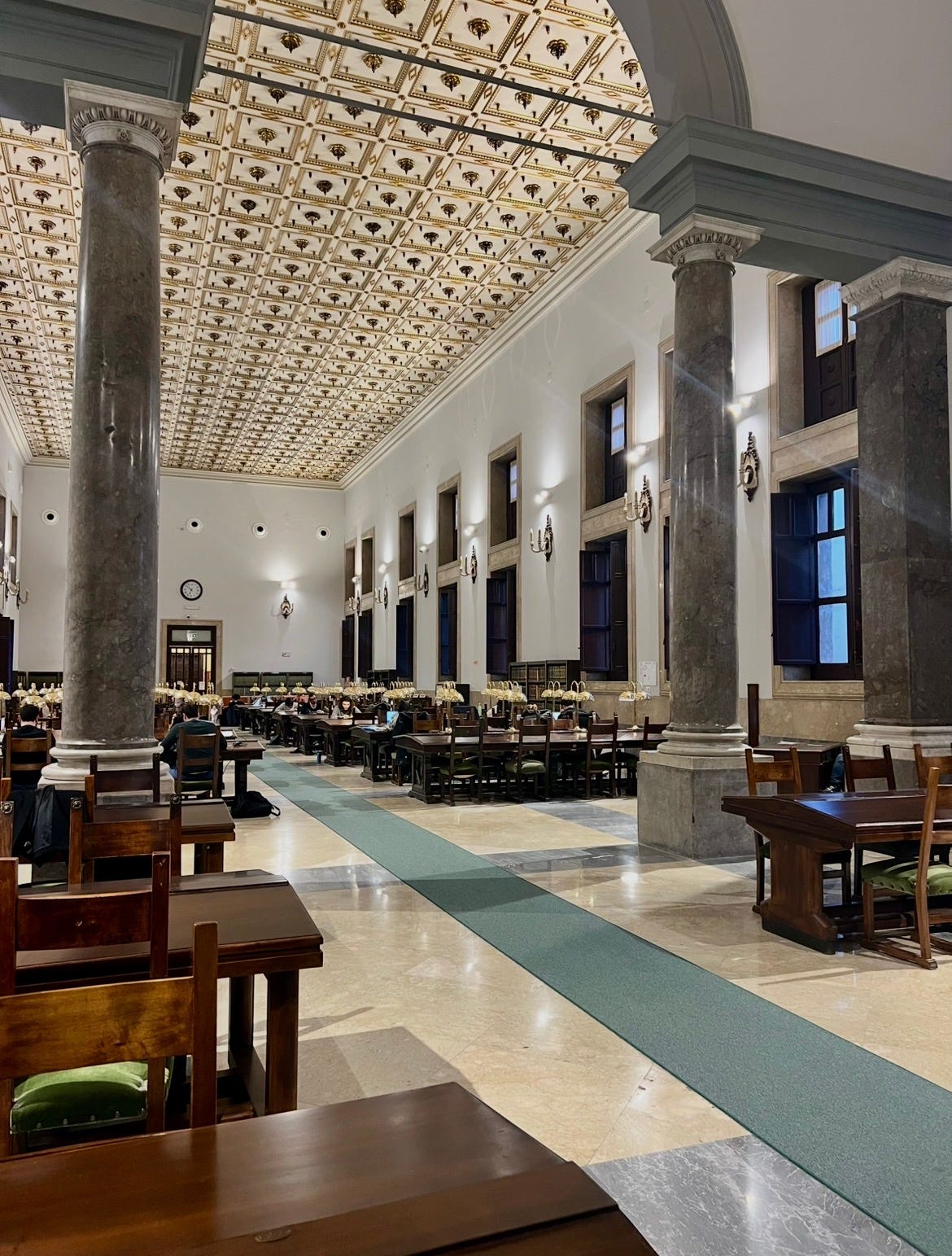
I’m reading Aistriú by Sinéad Ní Shúilleabháin, beavering away at various writing projects in the library and enjoying Sicilian weather now far more than I would in the summer. I would move to Southern Italy permanently and without question were it not for a little thing called heat.
Mach’s gut.
N